Home/Sleep Guides/Sleep Position
Sleep PositionFour alignment mistakes that are wrecking every side sleeper’s morning
Side sleeping is the most popular position and the most demanding on your bedding. Four alignment problems it creates, and how to correct every one of them.

Somewhere between sixty and seventy percent of adults spend most of the night on their side, which makes it comfortably the most popular sleeping position in the country. It is also, and this is the part almost nobody is told, the position that places the highest demands on your bedding. Back sleeping is relatively forgiving because your weight spreads across a wide, flat surface. Side sleeping concentrates your entire body weight onto two narrow contact points, your shoulder and your hip, and it opens a gap under your neck that nothing about your anatomy fills on its own.
Marisa found this out the hard way. She had been a side sleeper her whole life, had never thought about it once, and at thirty four started waking with a right shoulder that ached deeply enough that she began avoiding overhead reaching at work. Her doctor found nothing wrong with the joint. A physical therapist gave her rotator cuff exercises that helped marginally. What eventually solved it was not a treatment at all, it was the realization that she had been sleeping for years with her entire upper body weight funneling through one shoulder because her pillow was not doing the job a side sleeper's pillow has to do.
This guide covers what side sleeping actually asks of your body, the four alignment problems it creates, and how to correct each one. If you sleep on your side and you wake up sore anywhere between your jaw and your lower back, there is a good chance the explanation is here.
Why side sleeping is the most demanding position
Lie on your back and your weight distributes across your shoulder blades, your ribs, your pelvis and your calves. Roll onto your side and almost all of it transfers to two bony prominences, the head of your upper arm bone at the shoulder and the greater trochanter at the hip. Those are small surfaces carrying large loads, which is why side sleepers report pressure point pain far more often than back sleepers do.
At the same time, rolling onto your side opens a triangular void between the side of your head and the mattress. The width of that void equals the distance from the outer edge of your shoulder to the side of your neck, which for most adults is somewhere between four and six and a half inches. If nothing fills it, your head simply falls into it and your neck bends sideways for the entire night.
There is a third demand that people rarely consider, which is what happens to your lower body. With your legs stacked, the upper leg tends to slide forward and down under gravity, rotating your pelvis and putting a twist through your lumbar spine. Side sleeping therefore creates alignment problems at three separate levels, and solving only one of them explains why so many people make a change, feel a partial improvement, and conclude that side sleeping is just uncomfortable.
Side sleeping does not cause pain. Unsupported side sleeping causes pain, and the distinction matters because one of those is a position you would have to give up and the other is a setup you can fix.
Problem one: the shoulder gap that nothing fills
This is the defining problem of side sleeping and the one that a standard rectangular pillow handles worst. The gap you need to fill is not a small hollow, it is the full width of your shoulder, and it demands substantially more pillow height than any other sleeping position.
When the gap is underfilled, your head drops toward the mattress and your neck bends downward. The muscles along the upper side stretch and stay stretched, the joints on the lower side compress, and both of those tissues are held that way for hours. The resulting pain is characteristically one sided and appears on whichever side you sleep on most, which is a useful clue because a genuine structural problem would not politely restrict itself to your preferred sleeping side.
When the gap is overfilled, the opposite happens and your head is pushed upward, bending your neck toward the ceiling. This tends to produce a tighter, more compressed feeling across the back of the neck, along with the sensation that your airway was slightly restricted. Both errors are common and both are entirely solvable by getting the pillow height right, which is worth measuring rather than guessing.
The measurement is simple. Stand with your back flat against a wall, measure from the wall to the outermost point of your shoulder, then measure from the wall to the side of your neck, and subtract. That difference is what your pillow needs to fill when you are on your side. Subtract about an inch if your mattress is soft, since your shoulder will sink into the surface and close part of the gap on its own.
Problem two: your shoulder is carrying your head
This is what happened to Marisa, and it is the least understood of the four problems. When a pillow does not adequately fill the shoulder gap, the weight of your head does not simply vanish. It transfers downward into the shoulder joint underneath, which then spends seven hours bearing a load it was never designed to carry in a static position.
The symptoms are distinctive once you know them. A deep ache inside the shoulder joint rather than on the surface, worse in the morning, worse on the side you sleep on, and often accompanied by a reluctance to raise the arm overhead. Many people also find they wake with a numb or tingling hand, because the compressed tissue in the shoulder and upper arm restricts nerve and blood flow through the night.
There is a second and even more common version of this, which is the habit of tucking one arm underneath the pillow. Almost every side sleeper does this at some point, and the reason is instinctive rather than random. Your body is improvising the pillow height that the pillow itself failed to supply, using your own arm as filler. It works, in the sense that it raises your head, and it costs you a compressed arm and a numb hand by morning.
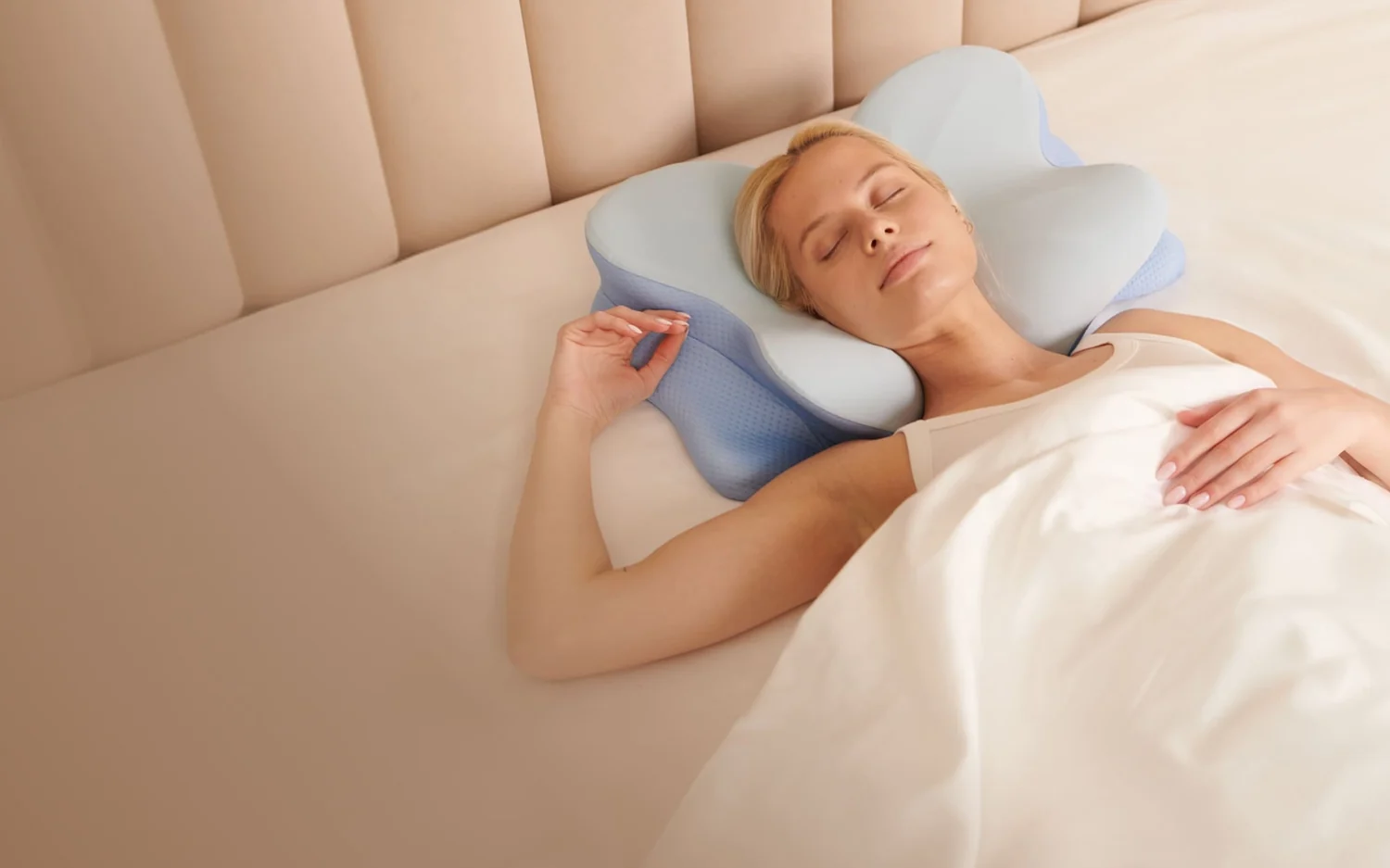
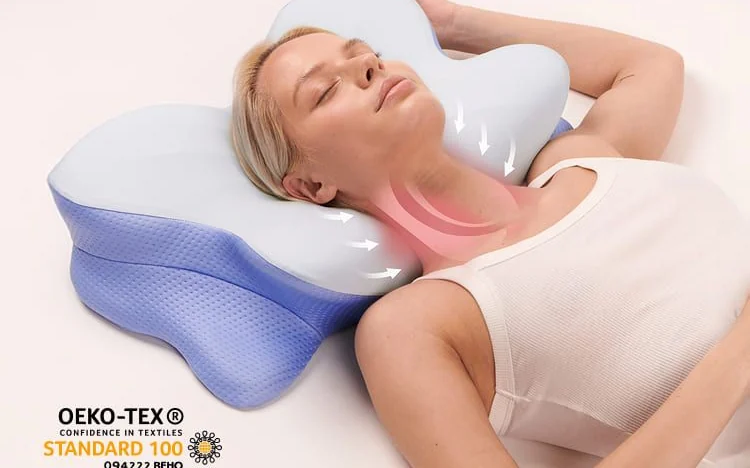
The correction is twofold. The first part is getting the pillow height right so that your head is fully supported and no weight travels down into the shoulder. The second is choosing a pillow shape that gives your under arm somewhere to go, which is why the better ergonomic designs include recessed pockets along the lower edge specifically for this. The Derila Ergo builds these arm pockets directly into the butterfly shape, and side sleepers consistently name them as the feature they did not expect to care about and would not now give up.
Problem three: the pelvic twist you sleep through
With your legs stacked one on top of the other, the upper leg is not stable. Gravity pulls it forward and down across the lower leg, and because your thigh is attached to your pelvis, the pelvis rotates with it. That rotation travels up into your lumbar spine as a sustained twist, held for as long as you stay in that position.
Lower back stiffness on waking, particularly on one side, is the most common result. Some people also report hip pain that they attribute to the mattress being too firm when the actual issue is rotational rather than compressive. The tell is that the discomfort is asymmetrical and corresponds to the side you sleep on.
The fix is genuinely one of the highest value changes a side sleeper can make and it costs almost nothing. Place a pillow between your knees, thick enough that your upper thigh stays roughly parallel to the mattress rather than dropping. This holds your pelvis square, removes the twist from your lumbar spine and, as a bonus, stops your knees pressing against each other. People who try this for a week are frequently surprised by how much lower back stiffness disappears from something that took no effort at all.
Built for the position you actually sleep in.
Raised shoulder arches fill the side sleeper gap, and recessed hand pockets give your under arm somewhere to rest instead of being crushed beneath you.
Check Today's Bundle Prices →60 night home trial · Free US shipping · Up to 60% off bundles
Problem four: pressure at the hip
The last of the four is straightforward compression. Your hip is one of only two points bearing your body weight, and if your mattress is too firm to allow it to sink appropriately, the tissue over the bone gets compressed for hours at a time.
This produces a soreness right over the outer hip that is often worst on first standing up and eases within a few minutes of walking. It is much more common in people with less padding over the joint and in anyone sleeping on a firm mattress or a thin mattress topper.
The solution here is at the mattress level rather than the pillow level. Side sleepers generally do best on a medium to medium soft surface that allows the shoulder and hip to sink in while still supporting the waist. If replacing a mattress is not on the table, a two or three inch memory foam topper achieves much of the same effect for a fraction of the price and is one of the more reliable upgrades a side sleeper can make.
Does it matter which side you sleep on?
It does, modestly, and for reasons that have nothing to do with your neck. Sleeping on your left side is generally the better default for anyone prone to acid reflux or heartburn, because of the way the stomach and the junction with the esophagus are oriented. Left side sleeping is also the standard recommendation during pregnancy, since it improves circulation to the uterus and reduces pressure on the major vein returning blood from the lower body.
Sleeping on the right side is not harmful for most people and some find it more comfortable, particularly anyone with shoulder pain on the left. The practical advice is to favor your left if you have reflux and otherwise to sleep on whichever side is comfortable, while making a deliberate effort not to spend every night on the same one. Alternating sides distributes the load and prevents the one sided pattern that produces most side sleeping complaints in the first place.
Worth noting is that you cannot control this consciously past the point of falling asleep, and trying to is counterproductive. What you can control is which side you start on, and over time your starting preference does shift the overall distribution.
Building a side sleeping setup that actually works
Putting the four problems together produces a fairly short list of requirements, and it is worth thinking about them as a system rather than as individual purchases, because they interact.
Your pillow needs enough height to fill your shoulder gap completely, which for most side sleepers means noticeably more loft than a back sleeper needs. It needs enough density to hold that height for seven hours rather than compressing to half of it by two in the morning, which is where cheap fill fails and dense memory foam succeeds. It ideally needs a shape that accommodates your under arm rather than forcing it beneath your body. Your knees need something between them to keep your pelvis square. And your mattress needs to be forgiving enough at the shoulder and hip to let them sink slightly rather than bearing all the pressure at the surface.
Get all five right and side sleeping stops being a compromise. Get four right and you will usually feel a large improvement with one lingering complaint, which is actually useful information, because whichever complaint remains tells you which of the five you have not addressed.
What to look for in a side sleeper's pillow
Height comes first, and it should be matched to your measured shoulder gap adjusted for your mattress firmness. Most side sleepers need something in the region of four and a half to six inches of effective loft, which is to say height under load rather than height on the shelf.
Density comes second and is easy to overlook, because a pillow that feels wonderfully supportive when you press it in a store can still compress badly under the sustained weight of a head over several hours. High density memory foam is the most reliable performer here, since it resists compression and returns to full shape each morning rather than gradually taking a permanent impression. The simple test on any pillow you already own is to press your palm into it and watch how quickly and completely it recovers.
Shape comes third and is where contoured designs pull ahead of rectangles for side sleepers specifically. A rectangle has to pick one height, which means it is either right for side sleeping and too tall for the times you roll onto your back, or right for your back and too flat when you turn over. A contoured pillow with a lower center and raised side arches provides both heights in one object, so changing position does not require any conscious adjustment.
Temperature comes fourth and matters more for side sleepers than for anyone else, because more of your face is in contact with the pillow surface. Solid foam blocks trap heat against your skin. Ventilated or perforated cores with a breathable knit cover move warm air away, and the practical difference is whether you spend the night hunting for the cool side of the pillow.
Side sleeping, snoring and why the position gets recommended
If you have ever been elbowed in the ribs and told to roll over, you have encountered positional snoring, and side sleeping is the standard first recommendation for it. The mechanism is simple. Lying on your back allows the tongue and the soft tissue at the back of the throat to fall backward under gravity, narrowing the airway and increasing the vibration that produces the sound. Turning onto your side moves that tissue out of the airway and the noise frequently drops substantially.
What is less widely known is that side sleeping only delivers this benefit if your head is properly supported. If your pillow is too flat, your head sags toward the mattress and your chin drifts toward your chest, which reintroduces the same airway narrowing you rolled over to escape. If your pillow is too tall, your head is pushed up and the angle at the front of your neck closes, producing the same result from the opposite direction. Plenty of people switch to side sleeping for snoring, see no improvement, and conclude the advice does not work for them, when in reality their pillow was undoing the position change.
This is one of the clearest arguments for treating side sleeping as a system rather than a position. The benefit comes from keeping the head and neck in a straight, neutral line, and the position alone does not achieve that. It is worth saying plainly that none of this addresses obstructive sleep apnea, which is a medical condition rather than a positioning problem. Loud snoring accompanied by gasping, choking or daytime exhaustion warrants a proper assessment rather than a change of pillow.
How long before side sleeping stops hurting?
People reasonably want to know how long they are signing up for before a new setup pays off, and the honest answer varies by which of the four problems you were dealing with. Correcting the shoulder gap with an appropriately sized pillow tends to produce the fastest results, with most people noticing meaningfully less morning neck stiffness somewhere between the end of the first week and the middle of the second.
Shoulder joint pain takes longer, because that tissue has usually been loaded improperly for months or years and needs time to settle once the load is removed. Two to four weeks is a realistic expectation, and improvement tends to be gradual rather than sudden. The lower back stiffness that comes from pelvic rotation is the fastest of the lot, and adding a pillow between the knees often produces a noticeable difference within three or four nights, which is why it is such a satisfying change to make first.
Hip pressure pain responds on a similar timescale to the shoulder, and depends heavily on whether you address the mattress or only the pillow. If you change your pillow and your hip still aches after a month, the pillow was never the relevant variable for that particular symptom and the surface underneath you is what needs attention.
Expect an adjustment period and plan for it
If you are moving from an underperforming pillow to one that properly fills your shoulder gap, the first few nights will probably feel too firm and too tall. This is normal and it is not a sign that you have chosen wrong. Your neck muscles have been compensating for inadequate support for a long time, and they hold that bracing pattern for several nights before they trust the new arrangement and let go.
The usual timeline is that nights one and two feel unfamiliar, nights three to five feel progressively more normal, and by the end of the first week most people stop noticing the pillow at all. Not noticing your pillow is the actual goal, and it is worth remembering that when night two tempts you to give up.
What is not normal is still actively fighting the pillow after ten consecutive nights. At that point the height is probably genuinely wrong for your frame or your mattress, and the answer is to reassess the measurement rather than to persevere. This is why a home trial period measured in weeks is far more useful than any amount of testing in a showroom, since ninety seconds lying on a display bed tells you nothing about how a pillow behaves across seven hours and fifteen position changes.
One honest caveat: if you sleep on your side but wake regularly with numbness that persists well beyond a few minutes, with weakness in the hand, or with pain radiating down the arm, that deserves a proper medical assessment rather than a new pillow. Positional numbness that clears within a minute or two of moving is ordinary. Numbness that lingers is not, and no amount of bedding will address it.
Where Marisa landed
Her measured shoulder gap was five and a quarter inches. The pillow she had been using compressed to roughly three inches under her head, which meant she had been sleeping with a two inch deficit every night, and her shoulder had been quietly absorbing the difference. She had also been tucking her right arm under the pillow for as long as she could remember, which she had always assumed was just a habit rather than a symptom.
She changed two things. A contoured pillow with enough height for her gap and recessed pockets so her arm had somewhere to rest, and a thin pillow between her knees, which she added mostly because it was free and she was already changing things. The shoulder ache took about three weeks to fully resolve. The lower back stiffness she had never even mentioned to anyone, because she assumed it was unrelated, disappeared within four nights of the knee pillow.
The rotator cuff exercises were not wasted, and the physical therapist was not wrong. But the exercises were treating a shoulder that was being reinjured for seven hours every night, which is why they helped a little and never quite finished the job. Side sleeping was never the problem. Side sleeping without support was, and support is a solvable problem.
Ready to fix the thing under your head?
The Derila Ergo is a butterfly ergonomic memory foam pillow with four support zones, a ventilated cooling core and a washable cover. Bundles are up to 60% off today with free US shipping.
See Today's Bundle Prices →60 night home trial · Free US shipping · 4.7 from 50,000+ owners
Keep reading
The two-minute measurement that ends years of pillow guesswork
Loft is the number one reason ergonomic pillows get returned. Here is how to measure yours in about two minutes, and why your mattress quietly changes the answer.

Why your neck hurts every morning, and the seven fixes that actually work
If your neck pain is worst before you have done anything and better after you have done everything, the problem is happening while you sleep. Here is how to find out which cause is yours.
Memory foam or a regular pillow: which one your neck actually needs
The qualities that make a pillow feel good in your hand have almost nothing to do with the qualities that support your neck for seven hours. Here is the honest comparison.