Home/Sleep Guides/Neck Pain
Neck PainWhy your neck hurts every morning, and the seven fixes that actually work
If your neck pain is worst before you have done anything and better after you have done everything, the problem is happening while you sleep. Here is how to find out which cause is yours.

For about two years, Dan's first conscious act of every day was a small negotiation with his own neck. He would wake, register the stiffness on the right side, and then spend a careful thirty seconds rotating his head through a limited arc to find out how bad it was going to be. Some mornings it was a five out of ten and he could get on with things. Other mornings it was bad enough that reversing the car out of the driveway meant turning his whole torso because his neck would not go far enough on its own.
He assumed it was age, then he assumed it was his desk, then he assumed it was stress, and at various points he tried a standing desk, a course of massage, a foam roller and a prescription anti inflammatory. Some of it helped a little. None of it fixed the pattern, and the pattern was the most telling thing about the whole situation, because the neck pain was always at its worst in the first hour after waking and almost always faded to nothing by mid morning.
That pattern is the single most useful diagnostic clue in the entire subject of morning neck pain, and it points somewhere very specific. If something you do during the day were the primary cause, the discomfort would build as the day went on. When neck pain peaks on waking and then eases, the seven hours you spend horizontal are the prime suspect, and that narrows the investigation considerably.
This guide walks through the seven causes that account for the overwhelming majority of morning neck pain, explains what each one feels like so you can tell them apart, and lays out the order in which to test them so you are not changing five things at once and learning nothing.
Why the pain is worst in the first hour
Your neck holds up a head that weighs roughly the same as a bowling ball, and it does so using a group of deep stabilizing muscles that run from the base of your skull down into your upper back. During the day these muscles are constantly making small corrections to keep your head balanced. At night they are supposed to stop, because your pillow and mattress take over the job of holding your head in position.
That handover is conditional. It only happens if your head is actually supported in a neutral position. When it is not, those muscles hold a low grade contraction all night to stop your head drifting further out of line, and a muscle that contracts continuously for seven hours without moving accumulates metabolic waste, loses circulation and stiffens. That is the sensation you wake up with. It fades within an hour or two of getting up because movement restores blood flow and flushes the tissue out.
If your neck pain is worst before you have done anything and better after you have done everything, the problem is almost certainly happening while you sleep rather than while you work.
This also explains why so many people with morning neck pain have unremarkable scans and examinations. There is frequently nothing structurally wrong. The tissue is behaving normally in response to being held in an abnormal position for a third of every day, and correcting the position corrects the symptom without any treatment at all.
Cause one: your pillow is the wrong height
This is the most common cause by a considerable margin, and it is also the easiest to fix, which makes it the obvious place to start. A pillow exists to fill the gap between your mattress and your head so that your neck stays in line with the rest of your spine. If it fills too much of that gap your head is propped upward, and if it fills too little your head sags downward, and either way your neck spends the night bent.
The two versions produce distinguishable symptoms. Too much height typically causes a tight, compressed ache spread across the back of the neck and the tops of the shoulders, sometimes with a dull headache starting at the base of the skull, and occasionally with a sense that your throat felt constricted overnight. Too little height typically causes sharper, one sided neck pain along with a shoulder that feels bruised or overworked, because more of your body weight has been pressing through that joint.
There is a quick way to check without buying anything. Lie on your side on your bed in your normal sleeping position and have someone photograph you from behind. Look at the line running from your tailbone through your shoulder blades and out through your head. If it bends upward at the neck, your pillow is too tall. If it sags downward, your pillow is too flat. A correctly sized pillow produces a line that looks boringly straight, and boring is exactly what you want.
Cause two: your pillow has quietly collapsed
A pillow can be the right height on the day you buy it and the wrong height eighteen months later without you ever noticing the transition, because the loss happens a fraction of an inch at a time. Polyester and down alternative fill are especially prone to this, since the fibers permanently compress and clump with use, but even low density foam takes a lasting impression of your head over time and stops rebounding fully.
The practical consequence is that a lot of people with morning neck pain are sleeping on a pillow that is functionally two inches shorter than the one they chose. Their neck sags all night, the muscles on the stretched side work overtime, and they wake with exactly the one sided stiffness described above, all while believing they are still using the good pillow they researched carefully three years ago.
The test takes five seconds. Press your palm firmly into the center of your pillow and lift it away. A pillow with life left in it returns to full shape within a few seconds. A pillow that keeps the dent, or returns slowly and incompletely, has stopped supporting you. Another version of the same test is to fold the pillow in half and let go. If it stays folded rather than springing open, its useful life is over.
Cause three: you sleep on your stomach
Stomach sleeping is comfortable for a lot of people and genuinely difficult to give up, but it is mechanically the hardest position on the neck by a wide margin. In order to breathe, you have to rotate your head roughly ninety degrees to one side and hold it there for hours at a stretch. No other sleeping position asks your cervical spine to sustain that much rotation.
What makes it worse is that stomach sleepers often use a normal height pillow, which adds extension on top of rotation and compounds the strain. If you sleep face down and you have morning neck pain, that combination is very likely your answer, and it tends to produce pain that is strongly one sided, always on the same side, corresponding to whichever direction you habitually turn.
Changing sleep position is hard and it is not a two week project, but it is achievable, and the usual approach is to make stomach sleeping less comfortable rather than to force yourself onto your side by willpower. A body pillow hugged along your front gives your arms and knees somewhere to go and makes the side position feel supported enough to stay in. If you cannot make the switch, the harm reduction version is to use the flattest pillow you can tolerate, since less elevation means less compound strain on an already rotated neck.
Cause four: your mattress is doing the wrong thing
Pillows get most of the blame for neck pain, but a mattress that has lost support in the middle changes the geometry of everything above it. If your hips sink into a soft spot, your spine curves, and your neck ends up compensating at the far end of that curve even though the original problem is two feet lower down.
This tends to produce neck pain accompanied by lower back stiffness, and that combination is a useful signal. If both ends of your spine complain in the morning, look at what your whole body is lying on rather than only what your head is lying on. Sit on the edge of your bed and look across the surface at eye level, since a visible dip or a sagging center is usually obvious once you look for it deliberately.
The mattress also interacts with pillow height in a way that catches people out. A soft mattress lets your shoulder sink, which reduces the gap your pillow needs to fill, while a firm mattress keeps your shoulder on the surface and widens that gap. This means the same pillow can be correct on one bed and wrong on another, and it explains why some people sleep beautifully in hotels and badly at home, or the reverse.
Most morning neck pain starts with the pillow.
The Derila Ergo holds a consistent height all night, preserves the natural curve of your neck on your back, and fills the shoulder gap when you roll onto your side.
Check Today's Bundle Prices →60 night home trial · Free US shipping · Up to 60% off bundles
Cause five: daytime posture debt you only feel at night
Spending eight hours a day with your head tipped forward toward a monitor or a phone loads the muscles at the back of your neck continuously. For every inch your head moves forward of your shoulders, the effective load on those muscles increases substantially, which is why people who work at screens accumulate a background level of tension they stop consciously noticing.
That tension does not usually cause acute pain during the day, because you keep moving and shifting. It shows up at night, when those already fatigued muscles are asked to hold a static position for seven hours. The result is a neck that was borderline all day and tips over into genuine stiffness by morning, and it is why people with desk jobs report morning neck pain at much higher rates than people with physically varied work.
The distinguishing feature here is that the pain is usually symmetrical across both sides of the neck and the upper trapezius rather than one sided, and it tends to be noticeably worse after a heavy work week than after a weekend. If that matches your experience, the fix is not only about the night. Raising your monitor so the top third is at eye level, taking a genuine break every hour, and doing a few simple chin tuck movements through the day reduces the debt you are carrying into bed.
Cause six: stress, clenching and a jaw you never think about
Nighttime jaw clenching and teeth grinding are far more common than most people realize, and the muscles involved connect directly into the same system that stabilizes your neck. Someone who clenches through the night is running a sustained contraction in the jaw, temples and upper neck for hours, and they wake up with stiffness that feels like a neck problem but originates a little higher.
The clues here are fairly distinctive. Morning jaw soreness, headaches concentrated at the temples, teeth that feel sensitive on waking, or a partner who has mentioned hearing grinding all point in this direction. Stress levels tend to track with severity, so if your worst mornings follow your most difficult days, that correlation is worth taking seriously.
This one is worth raising with a dentist rather than solving alone, because a fitted night guard is the standard and highly effective answer, and because untreated grinding damages teeth over time. It is also the one cause on this list where changing your pillow will help only marginally, so it is useful to identify early rather than after three pillow purchases.
Cause seven: you never move all night
This one sounds counterintuitive, because sleeping soundly without waking sounds like the goal. But healthy sleep involves regular small position changes, roughly ten to twenty across a night, and those changes exist partly to redistribute pressure and stop any one tissue being loaded for too long.
Alcohol, sedatives and sheer exhaustion all suppress those micro movements. Someone who falls asleep heavily and does not shift for four or five hours has effectively held a single posture far longer than their body intended, and they frequently wake with pronounced stiffness even when their pillow and mattress are perfectly adequate. If your worst mornings reliably follow evenings with a few drinks, this is likely part of your picture.
The related version is a sleep surface that makes moving difficult. Very soft mattresses and pillows that you sink deeply into can make repositioning require more effort, and some people simply do not surface enough to do it. A supportive surface that lets you roll easily encourages the natural movement pattern rather than suppressing it.
How to narrow it down without changing five things at once
The mistake almost everyone makes is to change everything simultaneously, which guarantees that even if the pain resolves you will not know what fixed it. A more useful approach is to work through the possibilities in order of likelihood and reversibility, giving each change enough time to produce a clear answer.
Start with the pillow, because it is the most likely cause, the cheapest to change and the fastest to give feedback. Do the palm press test to see whether your current pillow still rebounds, and take the photograph from behind to see whether your neck line is straight. If either test fails, that is your first change and everything else waits.
Give the new arrangement a full week of consecutive nights before judging it. This matters more than people expect, because a correctly supportive pillow often feels unfamiliar and even uncomfortably firm for the first two or three nights while your neck muscles stop bracing. Judging on night one is how a great many people abandon a solution that was actually working. If the morning stiffness is meaningfully reduced by the end of week two, you have your answer.
If a week on a properly sized pillow changes nothing at all, move to the mattress and to sleep position, then consider the jaw and the daytime posture contributors. Working in this order means that when something helps, you know what it was, and that knowledge is worth having the next time your circumstances change.
What good support actually looks like
A pillow that is doing its job holds your head at a height that keeps your neck level with your spine, maintains that height from the moment you lie down until the moment you wake, and gives your shoulder somewhere to sit rather than forcing it to bear the weight of your head. Those three things sound simple and most pillows fail at least one of them.
The first is a question of measurement, the second is a question of foam density, and the third is a question of shape. This is why contoured ergonomic designs have become the standard recommendation for people with persistent morning neck pain, because a shaped pillow can offer a lower zone for back sleeping and higher zones for side sleeping within a single surface, and can build in recesses that stop your shoulder and arm being crushed underneath you.
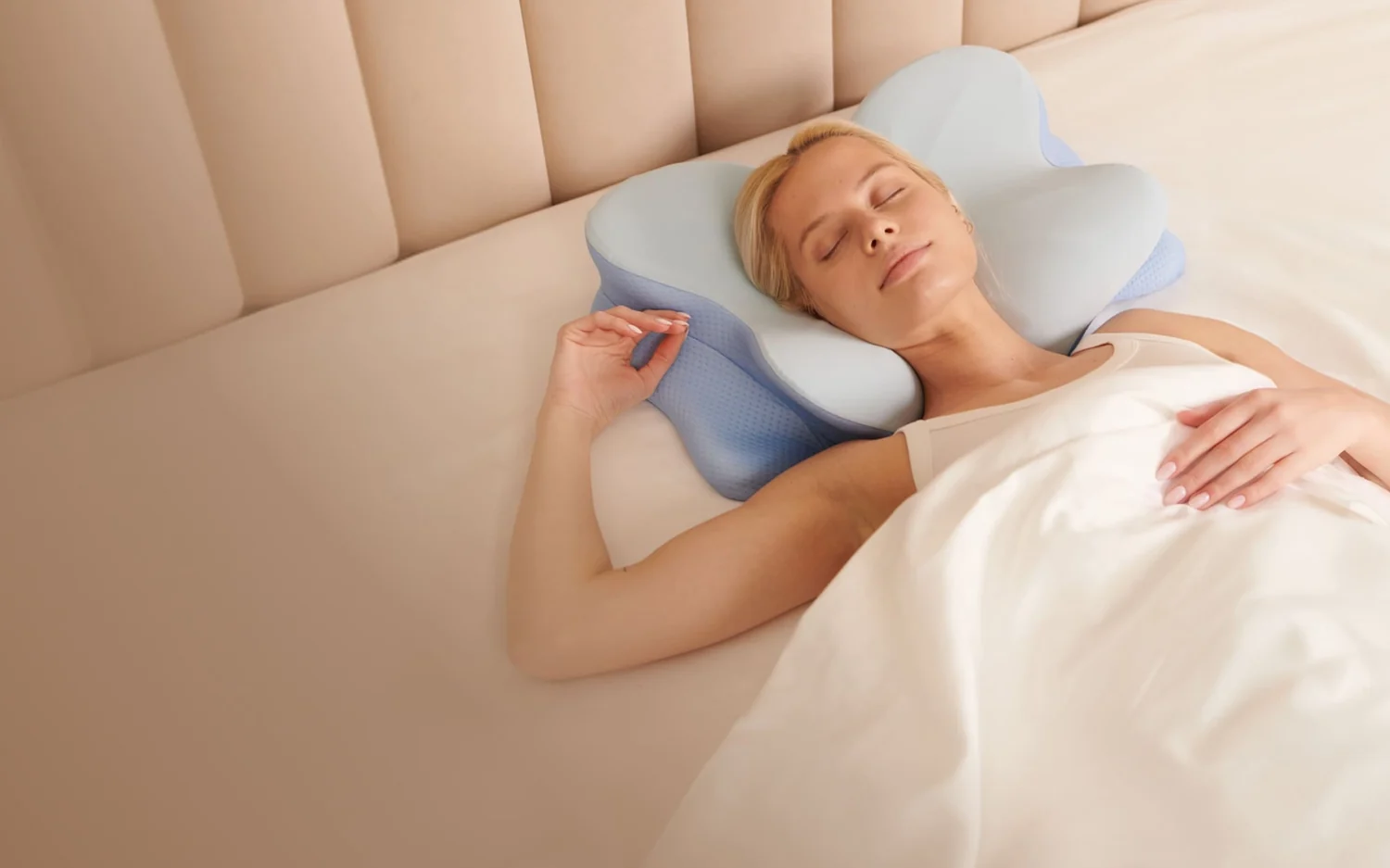
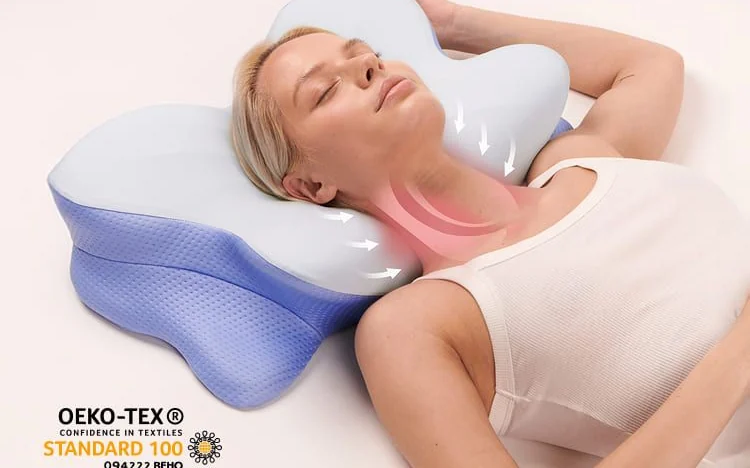
The Derila Ergo is built along those lines, with a central cradle that preserves the natural curve of the neck when you are on your back, raised arches on each side sized to fill the shoulder gap when you roll over, and dedicated pockets for your under arm. Whether you choose that particular pillow or another, those are the three functions worth checking for, because they map directly onto the three ways a pillow can leave your neck unsupported.
When to see a doctor rather than change your pillow: neck pain that radiates down an arm, numbness or weakness in the hand that does not resolve within minutes of waking, pain following any impact or fall, pain accompanied by fever or unexplained weight loss, or stiffness that steadily worsens over weeks rather than fluctuating should all be assessed by a healthcare professional. A pillow is a reasonable answer to postural morning stiffness and is not an answer to any of those.
Would sleeping without a pillow help your neck pain?
This suggestion circulates widely and it deserves a straight answer, because it is right for a small group of people and actively harmful for everyone else. Going without a pillow only makes sense if the gap between your head and the mattress is already close to zero, and there is exactly one sleeping position where that is true, which is lying face down. For a dedicated stomach sleeper, removing the pillow genuinely does reduce the extension being added on top of an already rotated neck, and many stomach sleepers with morning neck pain improve on a very thin pillow or none at all.
For a back sleeper, going without a pillow lets the head tip backward into extension and flattens the natural forward curve of the cervical spine, which is the opposite of neutral. For a side sleeper it is worse still, because the entire shoulder gap goes unfilled and the neck bends sideways for the whole night. In both cases the advice does not fix the neck pain, it changes which set of muscles gets overworked.
The kernel of truth buried inside the recommendation is that a lot of people are sleeping on far too much height, and reducing it helps. But reducing height is not the same as eliminating it, and the useful version of the advice is to match the height to your position rather than to abandon support altogether.
A five minute morning routine that speeds recovery
Whatever the underlying cause, the first hour after waking is when your neck is stiffest and most responsive to gentle movement, and a short routine makes a noticeable difference to how the rest of the day goes.
Begin before you get out of bed with slow head rotations, turning to look over each shoulder within a comfortable range and never pushing into pain. Follow that with gentle side bends, bringing each ear toward the corresponding shoulder and holding for a slow count of ten. These are not stretches in any aggressive sense, they are a way of restoring circulation to tissue that has been static for hours.
Once you are up, add a few chin tucks, which involve drawing your chin straight backward as though making a double chin, holding briefly and releasing. This activates the deep neck flexors that tend to be weak in anyone who spends time at a screen, and it directly counteracts the forward head position that builds tension through the day. A warm shower aimed at the back of the neck for a minute or two before all of this makes the tissue more cooperative.
None of this addresses the cause, and it is important to be clear about that. It manages the symptom while you work out which of the seven causes applies to you and change it. The routine is a bridge, not a destination.
What Dan's answer turned out to be
Dan's pillow failed the palm press test comprehensively. It kept the dent, and when he folded it in half it stayed folded, which meant it had been quietly providing less support every month for something like three years. The photograph from behind showed his head sagging noticeably below the line of his spine, and the one sided nature of his stiffness matched that picture precisely.
He replaced it with a contoured pillow sized properly for his shoulder width, and the first three nights were unimpressive enough that he nearly gave up. By the end of the first week the morning rotation test had gone from a genuine assessment to a habit he was performing out of memory. By the end of the second week he had stopped doing it at all.
The desk was not the problem, the stress was not the problem, and his age was certainly not the problem. He had spent two years managing a symptom while sleeping every night on the thing that was causing it, which is an ordinary and extremely common way for this to go. The useful lesson is not that pillows fix everything, because they do not. It is that when pain is worst on waking and better by lunchtime, the night deserves to be investigated first, and it usually is not.
Ready to fix the thing under your head?
The Derila Ergo is a butterfly ergonomic memory foam pillow with four support zones, a ventilated cooling core and a washable cover. Bundles are up to 60% off today with free US shipping.
See Today's Bundle Prices →60 night home trial · Free US shipping · 4.7 from 50,000+ owners
Keep reading
The two-minute measurement that ends years of pillow guesswork
Loft is the number one reason ergonomic pillows get returned. Here is how to measure yours in about two minutes, and why your mattress quietly changes the answer.

Four alignment mistakes that are wrecking every side sleeper’s morning
Side sleeping is the most popular position and the most demanding on your bedding. Four alignment problems it creates, and how to correct every one of them.
Memory foam or a regular pillow: which one your neck actually needs
The qualities that make a pillow feel good in your hand have almost nothing to do with the qualities that support your neck for seven hours. Here is the honest comparison.